Religious
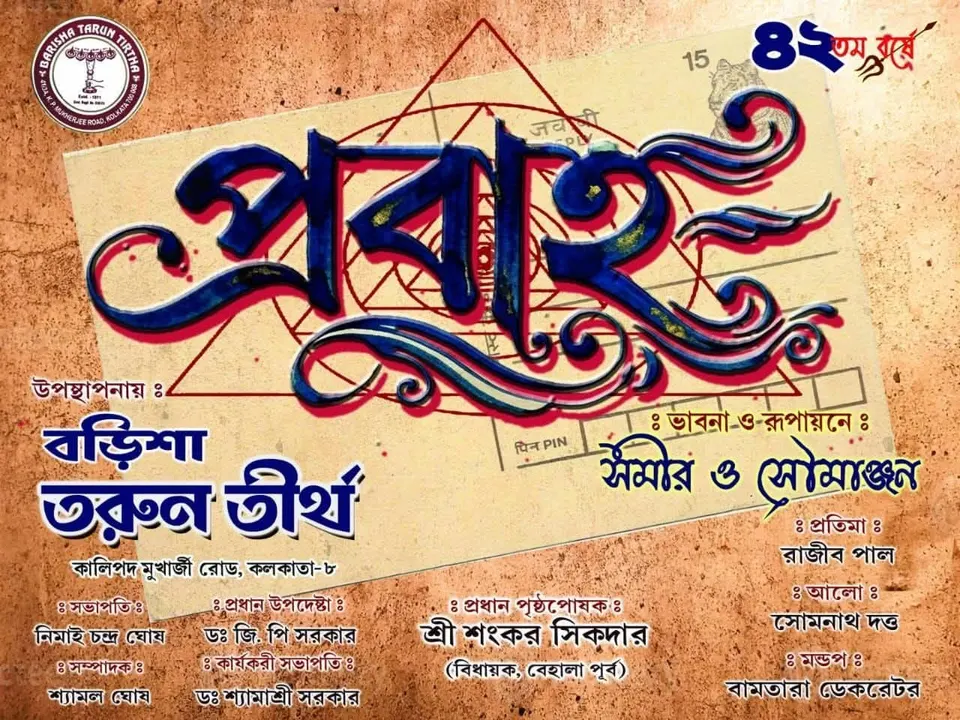
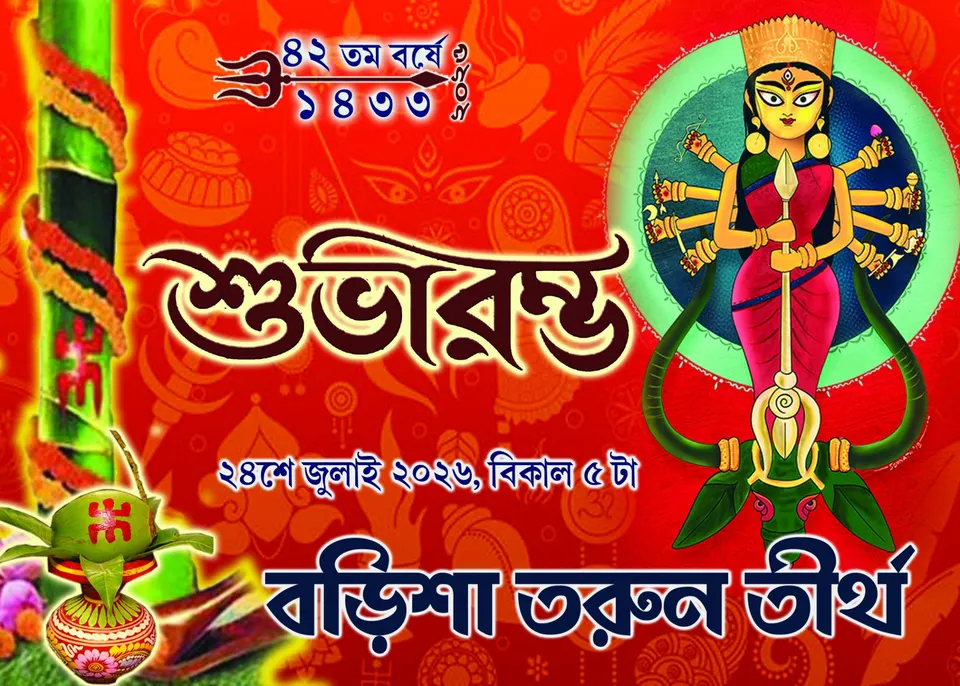
Khuti Puja (Durgotsav)
24 July 2026 · 5:00 pm · Barisha Tarun Tirtha, Barisha
- Event StatusCompleted
- Registration StatusNot Applicable
- Result DeclaredNot Applicable
- Prize Distribution StatusNot Applicable
Poetry, music, art, drama and festivals — the cultural heart of Barisha Tarun Tirtha.
Religious
24 July 2026 · 5:00 pm · Barisha Tarun Tirtha, Barisha
Religious
16 October 2026 – 21 October 2026 · Barisha Tarun Tirtha, Barisha
Religious
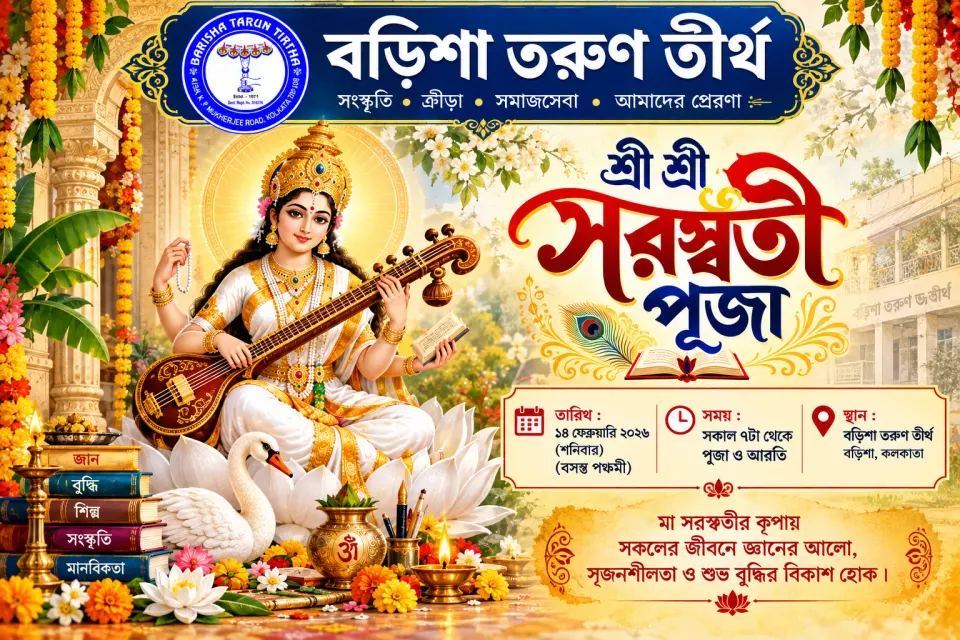
11 February 2027 · 7:00 am · Barisha Tarun Tirtha, Barisha
Cultural
Annual programme · Barisha Tarun Tirtha, Barisha (venue to be confirmed)
Cultural
Annual programme · Barisha Tarun Tirtha, Barisha (venue to be confirmed)
Cultural
Annual programme · Barisha Tarun Tirtha, Barisha (venue to be confirmed)
Competitions
Annual programme · Barisha Tarun Tirtha, Barisha (venue to be confirmed)
Cultural
Annual programme · Barisha Tarun Tirtha, Barisha (venue to be confirmed)
Cultural
Annual programme · Barisha Tarun Tirtha, Barisha (venue to be confirmed)
Cultural
Annual programme · Barisha Tarun Tirtha, Barisha (venue to be confirmed)
Cultural
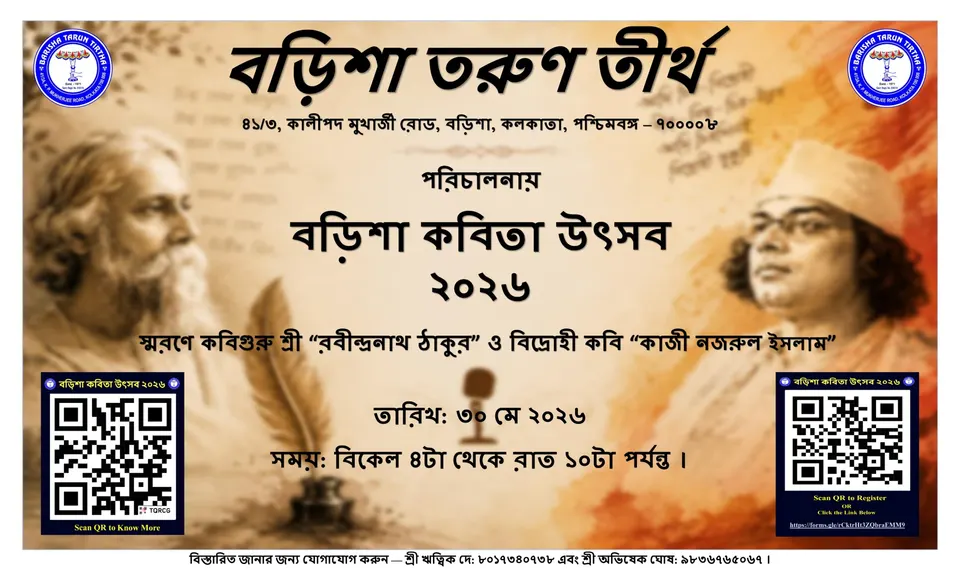
30 May 2026 · 5:00 pm · Barisha Tarun Tirtha, Barisha
Cultural
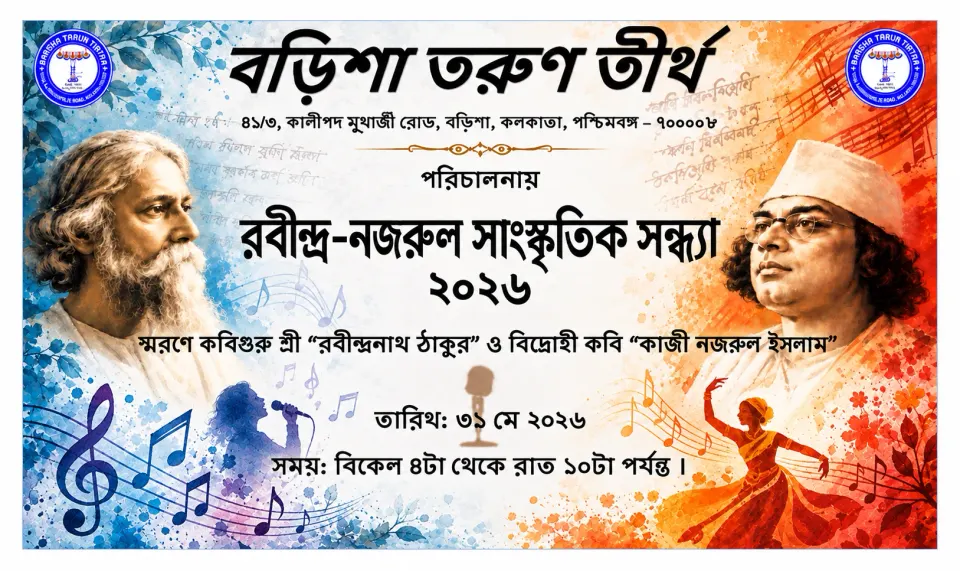
31 May 2026 · 4:00 pm · Barisha Tarun Tirtha, Barisha
Cultural
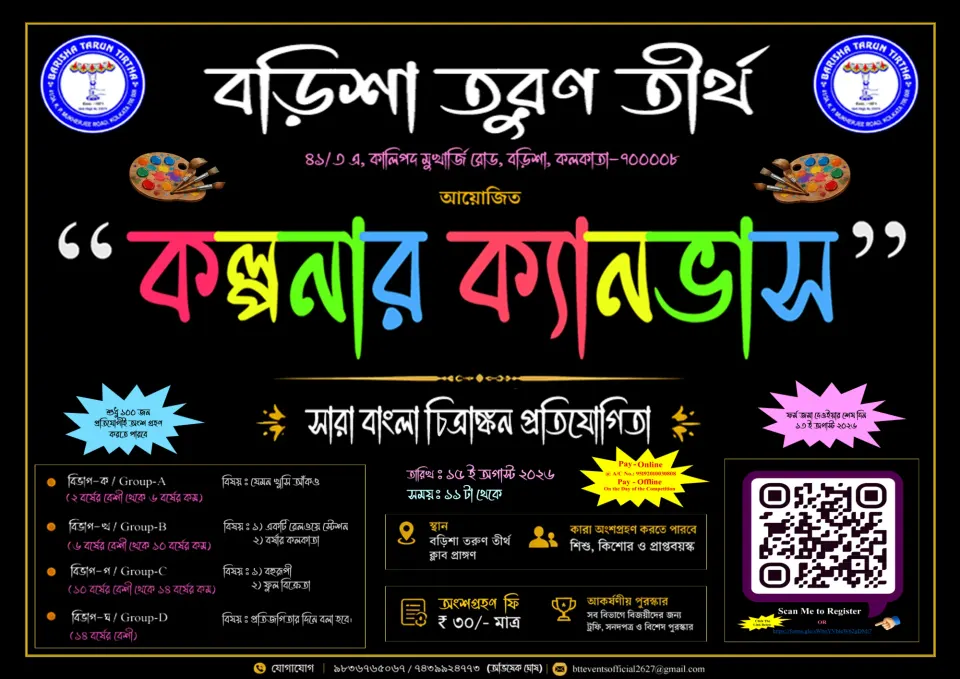
15 August 2026 · 11:00 am · Barisha Tarun Tirtha, Barisha
Cultural
31 December 2026 · 5:00 pm · Barisha Tarun Tirtha, Barisha
Cultural
22 March 2027 · 6:00 am · Barisha Tarun Tirtha, Barisha
Religious
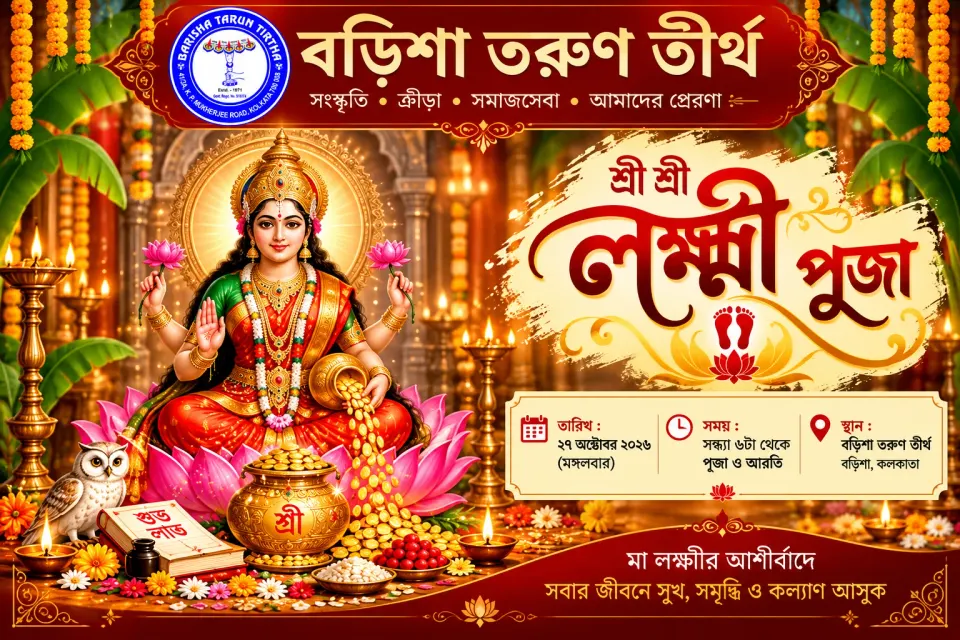
27 October 2026 · 6:00 pm · Barisha Tarun Tirtha, Barisha
Religious
30 October 2026 · 6:00 pm · Barisha Tarun Tirtha, Barisha
[Year]
Previous edition — Add a summary of the past edition, highlights and winners.
[Year]
Previous edition — Add a summary of the past edition, highlights and winners.
[Year]
Previous edition — Add a summary of the past edition, highlights and winners.
2025
Durga Puja 2025 — “Hutom Pyanchar Noksha” is a satirical sketch book depicting the society and life of 19th-century Kolkata. In it, the renowned author Kaliprasanna Singha presented the customs, superstitions, and vulgar aspects of the babu society through sharp satire. In the 41st Sharad Bhavna (Durga Puja theme) of Barisha Tarun Tirtha Club, through our humble efforts, we have sought to revive the Bengaliana of that era through the emotion-laden, near-extinct Tarja songs and Battala woodcut imagery of vintage Kolkata. Reforming contemporary moral values is our ultimate goal. The word ‘Tarja’ originates from the Arabic word ‘Tarjiband’ (a refrain or poetic stanza repeated periodically). Tarja is a form of verbal duel or poetic sparring. The verses are composed in rhythmic rhyming meters. Accompanied by the dhol (drum) and kansi (gong), the lead singers musically perform these question-and-answer rhymes on stage, showcasing their spontaneous improvisational prowess. However, its themes and scope are simple and brief. The practice of Tarja has also been documented in Persia and Roman amphitheatres. The subject matter of Tarja is primarily mythological. Artists draw stories from the Ramayana, Mahabharata, and the Vedas and Puranas based on their own knowledge and intellect. For this reason, Tarja performances were traditionally organized during community (barowari) pujas and religious festivities. The Tarja tradition flourished between 1760 and 1830. While it initially focused on mythological lore and moral lessons, over time, Kobigan and Tarja evolved into powerful satirical catalysts for social reform and awareness against British imperialism, social vices, the debauchery of zamindars and babus, and moral decay. Our presentation this year is an endeavor to revive this invaluable, nearly extinct art form to meet the needs of today.
2024
Durga Puja 2024 — The theme of our pandal decoration for this year’s Sharadotsav is ‘Dosor’. The word ‘Dosor’ means friend. In this modern age, deforestation is taking place on such a large scale that our human society will eventually face a crisis. Trees are our truest friends. If we cannot cultivate a friendly relationship with the environment, a time will come when we will not even be able to obtain the oxygen necessary for survival. Trees were created on Earth long before the emergence of mankind. Later, after human beings came into existence, they survived in a hostile environment solely by seeking shelter in trees. Humans began making clothes from tree bark, eating fruits and roots, and living inside tree hollows. One day, it was the trees that brought the pulse of life to a barren, desert-like Earth. Hence, trees are our primordial life. Conserving this friend is our imperative duty. It is within this mutual exchange of giving and taking that the rhythm of the relationship between trees and human life truly exists. Yet, humans continue to cut down trees regularly for their own selfish needs. As a result, they are bringing about their own ruin. Therefore, it is our duty to protect the surrounding environment and preserve this bond of friendship. Once this awareness awakens in every human being, people will no longer be so indifferent or cruel toward trees. The entire Earth will flourish with greenery, and our environment will transform into an earthly paradise.
2023
Durga Puja 2023 — For the past few decades in Bengal, art and society have been intrinsically intertwined with Durga Puja. Recently, Durga Puja received the UNESCO Intangible Cultural Heritage tag, largely due to the efforts of Tapati Guha-Thakurta. Alongside this, the ongoing Russia–Ukraine war is knocking on the doors of a third world war; furthermore, after nearly a century, we have lived through the harrowing experience of the COVID-19 pandemic, the lingering effects of which still persist. In such a volatile climate, being a contemporary artist places the very concept of “art for Puja” before a mirror of society, confronting critical questions. Beyond this, geopolitics, political decay, the naked face of sociological realities, shattered humanity, and helpless democracy leave an artist’s soul wounded, both within and without. To the common person, leading a healthy and normal life seems almost like an elusive dream. Hence, an artist’s perspective continuously shifts as torn pages from the diary of memory flutter by, transforming into a form of collage/montage that births a metamorphosis. This uneven blending of the aesthetics of the impossible creates a kind of “fusion”. The heart asks: if one does not act from the depths of one’s soul alongside the pulse of the times, then what is the purpose of all “this celebration and loud clamor?” Thus, spanning from mythology to Time and Space (Mahakal and Kali), traversing Semi-Abstract Expressionism, and incorporating the works and patachitra traditions of the world-renowned maestro Jamini Roy, who broke the mold of last century’s Kalighat patachitra to forge an original visual language, all these elements converge to shape this year’s experiment (montage). The essence of Durga Puja and worshiping the Mother lies in the vanquishing of evil and the welcoming of benevolence, the slaying of the demon within and without. Moving from “light emanating from the depths of darkness” and “this darkness, like the mysterious sister of light,” the journey heads toward luminescence: “The Journey Towards...” The flute of your light has begun to play, a journey from the very beginning, taking heart and soul as far as your infinite expanse can reach...
2022
Durga Puja 2022 — Holding boundless riches of creation within her womb, she is Shakambhari, the Mother of the Universe. Her world-enchanting, benevolent form is revered across the globe today. For so long, the passion of Bengalis revolved around this dispeller-of-distress form against all worldly injustice and adversity. But over time, that fervor crossed Bengal’s borders to touch the threshold of the global Bengali long ago; today, it has manifested in the form of Bhuvaneshwari. All this while, Bengalis remembered her in their hearts as Jagajjanani Sharada, and today that has gained universal acclaim through UNESCO’s recognition. Rising above caste, creed, and color, the Mother will now become the dispeller of sorrow in every home. Thus, completing her world voyage, her barge has anchored at our shores on this autumn morning. This joyous manifestation of her homecoming after conquering the world is ‘Bhuvaneshwari Sharada’.
2021
Durga Puja 2021 — This Durga Puja, “Sukhaloke Alimpon” (Anointing in the Light of Joy) celebrates the transition from darkness to light, depicting a joyful return to harmony, community, and the pristine warmth of traditional celebrations. Influenced by both the traditional festive spirit and an urgent call for natural reclamation, this theme emphasizes the triumph of life, culture, and nature over the artificiality and aggression of modern human overreach. Based on the image provided, the Pandal and open courtyard are designed to resembles a rural courtyard, inviting us to shed our urban, cage-like existences and touch the “soil of joy.” The walls are adorned with warm, earth-toned terracotta and ochre patterns, featuring hand-painted alpona (traditional decorative patterns), depicting deities, folk designs, and elements of nature. In the foreground, vibrant performance is underway, bringing together youth in traditional red-and-white attire performing folk dances, symbolizing a dynamic community spirit that celebrates together. A small sacrificial and offering fire burns, calling back to our primal connection with the sacred. At its heart, “Sukhaloke Alimpon” is an artistic attempt to return to our natural “wild” homes, the forests and open spaces that our aggressive modern existence has stripped away. Traditional artifacts, natural leaves, hand-rendered motifs, and open-air traditional Chandi-Mandaps take us back to a simpler time, when humans didn’t seek to cage nature but sought its protective, maternal embrace. Ultimately, the deity at the center, decorated with natural garlands and classic aesthetics, arrives to “subdue the wicked and protect the righteous,” ushering us from the captivity of a fast-paced world into a luminous, grounded awakening of joy, faith, and preservation.
2020
Durga Puja 2020 — Just as the light of sunset was descending upon a devastated earth, Mother Shakambhari awakened to the Vedic incantations of invocation to protect creation from the disaster of this great cataclysm. The Mother of the Universe appeared in her maternal form, holding the gesture of fearlessness (Barabhaya mudra) to set a paralyzed creation back in motion. Once Her divine, spiritual form is embodied in the clay idol, the light of life will awaken in homes shattered by the catastrophic cyclone Amphan; the dispeller of distress will slay the Mahishasura-like deadly virus and illuminate creation once more. With this prayer, our earnest plea this year is for You to appear with Your divine family to bring peace, becoming the beacon of light in our broken homes. May the sunrise of a new dawn bloom upon Your countenance.
2019
Durga Puja 2019 — When gray humanity wanders in search of a rainbow, seeking the trace of those colors fading from the mind’s palette, we set out to find the colors of celebration. We drape ourselves in it with pure fulfillment; the peacock of the mind spreads its vibrant feathers and begins to dance. In the radiant light of the Great Goddess, may every dream and hope across the colorful cosmos illuminate with distinct shades of varied dimensions. With this very hope of rediscovering the lost palette of colors amidst life’s wear and tear, we invite you to our pandal.
2018
Durga Puja 2018 — On 21st February 1952, countless young Bengali students stained the streets of Dhaka with blood, roaring with the slogan: “We want our mother tongue!” Amidst the tide of intense protests and the sacrifice of several fresh lives, the rulers’ conspiracy ultimately failed. The honor of the mother tongue, Bengali, was safeguarded. To honor this historic sacrifice for the mother tongue, UNESCO declared this special day as International Mother Language Day on 17th November 1999. To this day, it continues to be observed with great dignity across the world. Yet, it is a matter of profound regret that the self-oblivious Bengali of today is consciously beginning to forget their own proud mother tongue. In everyday practical life, they have ceased to consider Bengali indispensable. In the ambition to become international, they have gradually surrendered themselves to foreign languages and cultures. Consequently, the Bengali language has been severely neglected and pushed into the background. One’s mother tongue is the very identity of nationhood, the bearer of national culture. Therefore, the time has come to look back once more at the glorious past of our mother tongue. To bow down before Bengal’s rich, vast cultural and literary heritage, and to reclaim the honor of our mother tongue. Through our endeavor, we have tried to take a pledge to re-establish the dignity and prestige of our mother tongue. Join us, so that together we may dedicate ourselves to the sacred mission of restoring our mother tongue Bengali to its lost glory.
2017
Durga Puja 2017 — “My wish is to draw three eyes upon green leaves, And call you Mother today in the guise of the Forest Goddess.” In an urban life carpeted in concrete, while calculating what we want versus what we get, we forget that we are constantly losing the very air we breathe. Dethroning our sacred traveler-deity, the modernity we now worship is no goddess, she is a demoness. Our minds are enchanted by her charm, yet once the veil of that illusion lifts, we will face an endless darkness that even the neon lights of civilization will fail to dispel. Therefore, to escape this darkness cloaked in light, let an expedition toward green begin. Echoing the poet’s voice, let us say: “Give back that forest, take this city.” Yet the comforts of city life have bound us so tightly hand and foot that there is no true escape. But if we can lead our minds beyond the boundaries of urban existence and join the green expedition, only then will we be able to pay our humble homage to the nursing mother of civilization.
2016
Durga Puja 2016 — You are human; from the deepest depths of the ocean to outer space, everywhere lies your unchecked dominance. Everywhere on Earth, you have established your reign. You claim to be civilized! Is breaking down our dwellings, burning us alive by setting fire to home after home, and plundering everything we have earned a sign of civilization? You indulge in luxury solely by inflicting cruelty upon us, but no more. Your aggression has snatched away our forest; the days of sitting and dreaming in the green dimness of our wild homes are over. Our lives are being spent like caged convicts in your captivity. Therefore, we, the creatures of the wild, have sought refuge in the Goddess today; She is arriving to subdue the wicked and protect the righteous.
2015
Durga Puja 2015 — Natun Gram in the Burdwan district of West Bengal. Amid hundreds of villages in Bengal, the culture here is somewhat unique. Many years ago, when the forest-covered settlements of Bengal were ruled by the then Nawab, Alivardi Khan, Bengal’s soul trembled repeatedly under the attacks of Maratha bandits. To resist these recurring Bargi invasions driven by greed for Bengal’s rich agricultural wealth, Alivardi resorted to deception. Ultimately, he had the Maratha Bargi chieftain, Bhaskar Pandit, assassinated by an undercover killer and imprisoned the Bargi bandits. During their captive life in Bengal, a few creative individuals among these Marathas began carving idols and figurines. Since stone like that in Maharashtra was not easily available in Bengal, they chose cheap, soft wood as their medium. As a result, Maratha features began to emerge in Bengal’s wooden dolls. Over time, very little change occurred in their stylistic form. Although primarily created as playthings for children, their color brilliance is intensely striking. The structure is triangular, and when held lying down in one’s lap, it closely resembles an Egyptian mummy. Just as the jackal is the god of death in Egypt, here, alongside humans, the image of that same jackal god seems to be reflected in the owls. Hence, colorful brishakashtha (sacrificial carved wooden posts) craftwork made its way into the pavilions. Just as brishakashtha stands as a memorial to the soul merged into the Supreme Soul, its bright ornamentation in vibrant colors marks the boundary between the individual soul and the Supreme Soul. At one time, these dolls traveled by river route from Burdwan to Nadia in the likeness of Gauranga (Chaitanya Mahaprabhu), and they also arrived along the Adi Ganga at Kalighat in Kolkata for sale. Back then, they were known as “Ahladi Benebou” (the pampered merchant’s bride). With time, playthings have changed as well. Leaving wooden toys behind, soft toys and foreign Barbie dolls have taken their place. Consequently, this ancient doll art of Bengal has faded into the shadows of oblivion. We wanted to bring the new generation face-to-face with this ancient heritage; hence, we wanted to take young children into this imaginative land of wooden dolls.
2014
Durga Puja 2014 — “Why should woman not be given the right to conquer her own destiny...”, for her very existence lies at the foundation of creation. Thus, universal nature is the mother of the world. As the Cosmic Mother, we are blessed by the tender touch of her affectionate hands. Yet man, blinded by his own masculine pride, seeks to oppress the creator, forgetting that he himself is her creation. In this context comes the memory of Sonabai Rajwar. A homemaker from Puhputra, an obscure village in Chhattisgarh, this woman, stigmatized and childless, did eventually become a mother. Yet, after being scarred by prolonged psychological torment, an awakening was born from her suffering. Just as the muddy earth, cut and furrowed by the plow’s blade, yields golden harvests, so did her creation blossom like golden grain through an innovative art form of sculpting figurines using clay and cow dung. The artistic eye was spellbound by that vision of art. The brilliance of her creation, turning into the trident in the creator’s hand, slayed the beastly hearts of the detractors. It is a story of self-realization face-to-face with the divine while seeking the sweetness of one’s own inner self. The tale of an ordinary woman becoming extraordinary is our autumnal tribute this year, carrying the folk touch of Chhattisgarh’s living culture.
2013
Durga Puja 2013 — Rooted in the timeless mud-and-mirror art form of Kutch, Gujarat, “Otho Lippan Kotha” translates traditional indigenous craft into a sanctuary of divine reverence. The pavilion and the idol converge in a seamless aesthetic narrative, celebrating the humble alchemy of clay, earth, and light.
2012
Durga Puja 2012 — The ancient tradition of Bengal’s fairs is universally acknowledged. This coming together of people across many religions and castes has enriched Bengal’s cultural sphere, repeatedly uniting everyone in the courtyard of celebrations. Amid the gathering of autumn clouds and the sway of kash flowers, all Bengalis revel in the Sharad festival, “Our Dugga Puja”. This, too, is a fair of colors, a fair of union. Therefore, the Durga Puja of Bengalis is no longer merely a religious festival today. Transcending religion and caste, it is a grand gathering of countless souls; at the center of our theme in this vibrant, unconventional fair lies the Ferris wheel. Just as the Ferris wheel is inextricably linked to festivals, fairs, and colors, so too is it intertwined with the play of colors that make up human joy and sorrow. It reflects the rhythm of the whirlpool of everyday life and the watermark of an existence continually spinning within its vortex. This, too, feels like a fairy tale. A sliver of autumn sunshine and the blue sky beckon toward something different, toward other thoughts. The bird of a free spirit longs to spread its wings, “somewhere else, in some other place”. Eternal chanting of mantras, offerings for the puja, surrendering at the goddess’s feet, and the immersion of self-dedication. Then, once again, the monotonous shackles of daily life return. Within this whirlpool moves the perpetual rhythm of time’s law, continually spinning, endlessly turning around the central source of energy. This, too, is life’s Ferris wheel: a game of revolutions woven from joy, sorrow, smiles, and tears.
2011
Durga Puja 2011 — “Manush Gulo Shunyo Chhulo” captures humanity’s eternal yearning to break terrestrial boundaries, reach beyond worldly limitations, and touch the infinite cosmic void (shunyo). The installation blends primal folk motifs with futuristic, celestial architecture to illustrate humankind’s journey from the soil of the earth to the vastness of the cosmos.
2010
Durga Puja 2010 — The deepest realization of the poet Vidyapati, the feeling of eternal love, fulfilment and longing. In his verses, the poet deeply articulated the agony of feeling unfulfilled even after attaining everything: “Tell me, Madhava, how are you to me? Vidyapati says, the two have become one.” This is not a lifeless philosophical question; it is the very philosophy of life. In complete, blissful surrender, love does not cease. The infinity of life moves forward, taking the finite form of a profoundly wondrous question mark, who are you? It is the same question that lingers upon the cresting waves of a mysterious sea regarding the ocean itself; the question that rests upon the night sky’s Milky Way regarding the sky above. In the ledger of gains and losses, amidst the everyday misery of a hollow, selfish society, autumn still arrives, the bells of Bodhon ring, and the melody of Agamoni floats through the air. In the bow of surrender, the ceaseless endeavour to discover oneself within oneself goes on unabated. Behind the bonds of worldly ties, in the subtle hint of light and shadow, in the royal architecture of an ancient culture worshipping the Divine Mother, lies our blissful surrender. It is the quest for a fairytale far beyond the confines of earthly desires and attainments. Swaying between love and unlove, can the answer to that question truly be retrieved, even by diving deep into the fathomless depths of desire and longing? “The setting sun of the day Uttered the final question On the shore of the western sea In the silent evening, Who are you?”
2009
Durga Puja 2009 — Lalon Fakir’s timeless Baul song, “Khachar bhetor achin pakhi kemne ashe jay” (How does the unknown bird flutter in and out of the cage?), serves as the central allegory for this year’s Durga Puja. In Baul philosophy, the khacha (cage) represents the transient human body and material existence, while the achin pakhi (unknown bird) symbolizes the formless, divine consciousness dwelling within. Through this theme, the pandal bridges the mystic philosophy of Bengal’s rural soil with the grand arrival of the Divine Mother. Maa Durga’s autumnal descent to earth is envisioned as the cosmic achin pakhi briefly inhabiting our mortal world, reminding humanity that the divine is not an unreachable celestial entity, but an inward realization waiting to break free from earthly bounds.